


2026 Chinese Grand Prix Sprint Race: Have Red Bull sorted their issues?
:
The 2026 Chinese Grand Prix Sprint at the Shanghai International Circuit produced a surprisingly complex narrative for a race lasting just 19 laps.
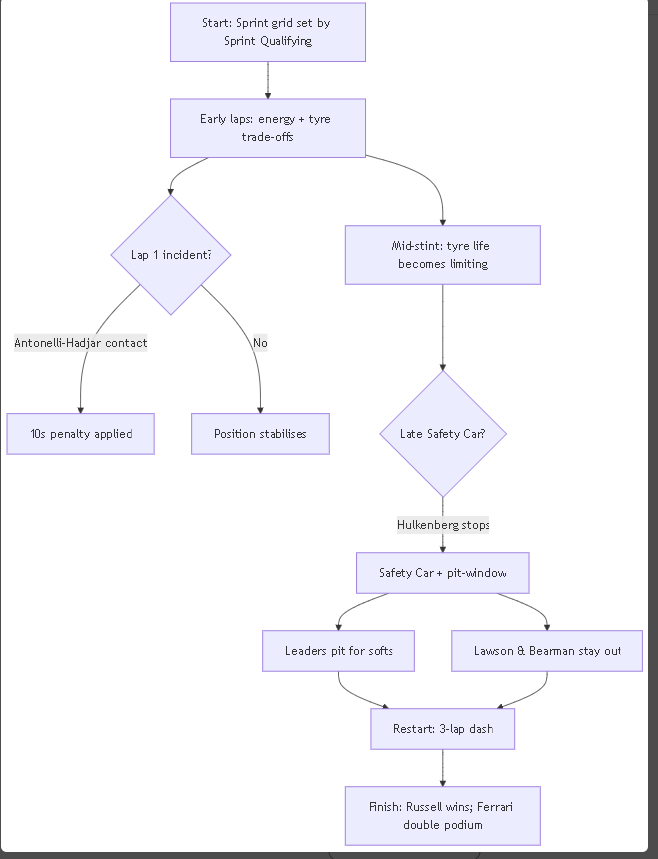
The event featured an intense fight for the lead influenced by the performance characteristics of the new 2026 power unit and aerodynamic regulations, while a late Safety Car period closed the field and created a short three-lap sprint to the finish.
Several penalties and mechanical concerns also reshaped the final order, significantly impacting how the Sprint points were distributed (Formula1.com, 2026; FIA, 2026; Reuters, 2026).
Starting from Sprint pole, George Russell successfully converted his front-row advantage into victory for Mercedes, holding off sustained pressure from Ferrari drivers Charles Leclerc and Lewis Hamilton.
The opening phase of the race saw multiple lead changes before Russell regained control and delivered a strong restart following the Safety Car intervention. Ferrari ultimately secured a double podium, demonstrating impressive pace throughout the Sprint, although Hamilton experienced tyre degradation after pushing hard early on, while Leclerc lost crucial momentum due to wheelspin at the restart (Formula1.com, 2026; FIA, 2026).
Further down the field, the fight for the final points-paying positions provided some of the most compelling moments of the race. Liam Lawson advanced into seventh place, while Oliver Bearman secured eighth after both drivers benefited from remaining on track when several competitors chose to pit during the Safety Car period. Meanwhile, Kimi Antonelli managed to recover to fifth position despite receiving a 10-second penalty for contact on the opening lap.
In contrast, Red Bull endured a difficult Sprint, with Max Verstappen suffering a power-related issue at the start and struggling with car balance and tyre degradation, ultimately finishing ninth and outside the points (Formula1.com, 2026; FIA, 2026; Reuters, 2026).
Looking ahead to the 56-lap main Grand Prix, the Sprint race offered several important clues about the likely competitive dynamics. Effective front-tyre management, particularly the heavily stressed left-front tyre at Shanghai, will be crucial. Mercedes also appeared to benefit from strong energy deployment efficiency on the circuit’s long straights, while Ferrari showed enough pace to challenge if it can minimise mistakes during wheel-to-wheel battles (Reuters, 2026; Formula1.com, 2026).

Team-by-Team Performance Analysis
A quick snapshot helps frame the deeper narrative (Sprint grid → Sprint finish, points scored, and primary operational story). (FIA, 2026; Formula1.com, 2026).
Team | Finish (best / second) | Sprint points | Biggest strategic/operational story | Primary improvement target for main GP |
Ferrari | P2 / P3 | 13 | Double podium; race pace strong but internal combat time-loss and restart wheelspin decisive | Preserve tyres in lead battles; convert pace without “self-cost” |
Mercedes | P1 / P5 | 12 | Victory plus recovery to P5 despite 10s penalty; strong energy/straight efficiency | Cleaner second‑car execution (starts, contact risk) |
McLaren | P4 / P6 | 8 | “Maximum” result per Norris; procedural discipline after restart | Reduce deficit to Mercedes/Ferrari in stint pace |
RB / Racing Bulls | P7 / DNF | 2 | Lawson stayed out late and converted track position into points | Convert the second car into reliable finishes |
Haas | P8 / P10 | 1 | Bearman stayed out late to steal a point; Ocon solid | Qualifying position and first‑stint pace |
Red Bull Racing | P9 / P15 | 0 | Start power issue + degradation; contact/damage for second car | Reliability and balance/degradation control |
Sauber/Audi | P13 / DNF | 0 | Hulkenberg stoppage triggered Safety Car; Bortoleto steady | Reliability and late‑stint robustness |
Williams | P12 / P16 | 0 | Strong recovery from deep grid slots | Qualifying execution and start phase |
Alpine | P11 / P14 | 0 | Gasly slipped from P7; team fined for unsafe release condition | Operational detail; protect track position during pit sequences |
Aston Martin | P17 / P18 | 0 | Minimal progress; remained in lower midfield/rear group | Pace baseline; start and early lap positioning |
Cadillac | P19 / DNF | 0 | Perez started by permission; Safety Car penalty; Bottas power failure | Reliability and process discipline under Safety Car |
Red Bull Racing
Red Bull’s Sprint was a compounded underperformance rather than a single “bad break”. Verstappen lost ground at the start due to a power issue and then described a car that degraded more than those around him, leaving him P9 and outside the points even after a late Safety Car stop for fresh tyres. (Formula1.com, 2026; FIA, 2026).
Hadjar’s race was compromised twice: first by Lap 1 contact (for which Antonelli was penalised), and then by needing to manage the consequences through a Sprint that offered limited recovery time. The stewards later issued him a warning for a separate procedural matter (practice-start instructions), a reminder that small compliance issues are amplified on Sprint weekends where sessions come rapidly. (FIA, 2026; FIA, 2026; Formula1.com, 2026).
What Red Bull did well was limit the damage to both cars finishing (Hadjar classified, Verstappen recovered to the edge of the top ten). What could have been improved is structural: start reliability and drivability/tyre degradation control appear essential before the 56‑lap race. (Formula1.com, 2026; Reuters, 2026).
Mercedes-AMG PETRONAS F1 Team
Mercedes combined raw speed with tactical clarity. Russell’s win came after absorbing repeated early attacks and then reclaiming control with a Turn 14 pass on Lap 5, before executing the late restart cleanly when the Safety Car removed his margin. (Formula1.com, 2026; FIA, 2026).
Antonelli’s P5 masks an extremely eventful Sprint. He was penalised 10 seconds for Lap 1 contact, and Formula1.com described him serving the penalty during the Safety Car pit sequence—reducing relative time loss versus a green‑flag stop—before still recovering positions to finish fifth. (Formula1.com, 2026; FIA, 2026).

On the technical side, the FIA Technical Delegate’s report notes a left‑hand‑side front wheel retention device replacement on Antonelli’s car prior to the Sprint—an example of the kind of pre‑race rectification that can matter in the reliability “teething” phase of new regulations. (FIA, 2026).
Mercedes’ key improvement point is reducing the probability of “avoidable” second‑car complications (start issues or contact risk) because Sprint weekends compress learning time and increase exposure. (FIA, 2026; Formula1.com, 2026).
Scuderia Ferrari
Ferrari’s double podium was a meaningful pace signal: Leclerc finished 0.674s from the win and set the Sprint’s fastest lap, while Hamilton led early and still fought back to third after losing positions during the late pit sequence. (FIA, 2026; Formula1.com, 2026).
Ferrari’s “performance story” split into two tyre narratives. Hamilton acknowledged his aggressive battle cost his left tyre, limiting his ability to sustain the lead fight, while Leclerc explained that colder-than-expected tyres on the restart led to wheelspin that prevented a final attack on Russell. (Formula1.com, 2026).
Strategically, Ferrari’s vulnerability was not the decision to pit under Safety Car—it was the time lost via intra-team fighting and the operational complexity of double-stacking under late caution. Ferrari did well to secure two podiums; it can improve by executing a more ordered resource strategy if both cars are genuinely in a win fight. (Formula1.com, 2026; Reuters, 2026).
McLaren
McLaren scored solid points (P4 and P6) but emerged as the clearest “best of the rest” rather than a lead contender. Norris described P4 as effectively the maximum possible despite the pace deficit to Mercedes and Ferrari, which is analytically important: it implies the gap is not simply down to traffic or a single setup choice, but a broader performance delta. (Formula1.com, 2026).
The team’s Sprint was also a case study in procedural execution. During the Safety Car restart, Piastri initially got ahead of Antonelli but was instructed to give the place back because he passed before the start/finish line, preventing a potential penalty and stabilising the result. (Formula1.com, 2026).
McLaren did well to convert a competitive Sprint Qualifying position into points without strategic overreach. The improvement area is race-stint competitiveness—especially if Sunday becomes a conventional tyre/pace contest rather than a late-neutralisation scramble. (Formula1.com, 2026; Reuters, 2026).
Aston Martin Aramco F1 Team
Aston Martin’s Sprint reflected lower‑midfield baseline pace: Alonso and Stroll finished P17 and P18, essentially mirroring their grid positions and indicating limited ability to gain either through overtaking or the Safety Car strategy phase. (Formula1.com, 2026; FIA, 2026).
There were no headline incidents or penalties attached to the team, which suggests clean execution but insufficient pace. For Sunday, the constructive focus is on improving early-lap positioning and managing tyre life well enough to capitalise if others fall away. (Formula1.com, 2026; Reuters, 2026).
BWT Alpine F1 Team
Alpine’s Sprint was defined by lost opportunity for Gasly. Starting P7, he finished P11, a four‑place drop that suggests either tyre-life limitations, adverse timing in the Safety Car pit cycle, or an inability to defend once the field re‑compressed. (Formula1.com, 2026; FIA, 2026).
Operationally, Alpine received a €5,000 fine after Gasly’s car left the garage for reconnaissance laps with an antenna shield still attached, which later dislodged on track. The stewards treated it as an unsafe release condition, and the report explains the team’s internal decision-making and why it was deemed unacceptable. (FIA, 2026).
Colapinto improved from P16 to P14, a modest but useful indicator of race-trim competitiveness. For Sunday, Alpine’s improvements are more procedural than philosophical: reduce operational risk, protect track position, and avoid avoidable distractions in a rules-heavy sprint weekend. (Formula1.com, 2026; FIA, 2026).
Atlassian Williams Racing
Williams quietly produced one of the strongest relative recoveries. Sainz climbed from P17 to P12 and Albon from P22 to P16, the joint-highest classified position gain in the field, implying the car had more race-stint capability than its Sprint Qualifying positions suggested. (Formula1.com, 2026; FIA, 2026).
There is also a broader “rules-era” context around energy modes. Reuters reported Sainz criticising energy-assisted overtakes as artificial, which is relevant not as opinion, but because it signals how drivers are adapting their racecraft to the new 2026 tools. (Reuters, 2026).
Williams’ priority for the Grand Prix is straightforward: qualify higher to reduce the work required in the race. The Sprint suggests that if Williams starts closer to points positions on Sunday, it may have a credible chance to defend or capitalise. (Formula1.com, 2026; Reuters, 2026).
RB / Visa Cash App RB – Visa Cash App Racing Bulls F1 Team
Racing Bulls’ Sprint outcome was asymmetric: one car scored, the other did not finish. Lawson’s jump from P13 to P7 was enabled by two elements—clean race execution and the strategic choice to stay on track when the leaders pitted under the late Safety Car, turning a likely non-points finish into two points. (Formula1.com, 2026; FIA, 2026).
Lindblad’s Sprint ended in retirement after an opening-lap spin, with Formula1.com recording him among the three non-finishers. In Sprint weekends, losing car #2 data is costly because the schedule already limits long-run learning. (Formula1.com, 2026; FIA, 2026).
The team did well through tactical courage with Lawson; what can be improved is converting both cars into consistent finishes, because the format rewards opportunism only when the car is still circulating at the end. (Formula1.com, 2026).
Sauber/Audi – Audi Revolut F1 Team
Audi’s Sprint was race-shaping: Hülkenberg’s stoppage at Turn 1 forced the late Safety Car that reset strategy for the entire field. That is a high-impact reliability failure, because it affects both the team’s own result and the competitive landscape for rivals. (Formula1.com, 2026; Reuters, 2026; FIA, 2026).
On the positive side, Bortoleto finished P13, holding a stable midfield position across a Sprint that saw significant pace differentials and strategic disruption. While not points-paying, it is a baseline performance to build upon for Sunday if reliability holds. (FIA, 2026; Formula1.com, 2026).
The obvious improvement target is durability: a clean 56‑lap race is the only way to turn midfield pace into meaningful outcomes in the new era. (Reuters, 2026; FIA, 2026).
Haas F1 Team
Haas executed the kind of “Sprint logic” that can transform outcomes. Bearman finished P8 and scored the final point largely because he stayed out under the late Safety Car while many rivals pitted, then defended position to the flag. Ocon finished P10, holding the top‑ten fringe. (Formula1.com, 2026; FIA, 2026).
What Haas did well was situational awareness: it treated the Sprint as a position-defence contest once the race became a three-lap dash. The improvement area is getting both cars closer to points on pure pace—because a Safety Car will not always arrive at precisely the right moment. (Formula1.com, 2026; Reuters, 2026).
Cadillac Formula 1 Team
Cadillac’s Sprint was shaped by pre‑Sprint problems and in‑race penalties. Perez did not set a Sprint Qualifying time within 107% but was permitted to start, with the stewards referencing satisfactory practice pace; Reuters also reported he missed the Sprint Qualifying session due to a fuel system issue. (FIA, 2026; Reuters, 2026; Formula1.com, 2026).
Perez finished P19 after receiving a five‑second penalty for a Safety Car ECU minimum-time infringement, while Bottas retired with a loss of power (recorded as DNF). That is a heavy reliability and compliance cost for a new entrant on a Sprint weekend. (FIA, 2026; Formula1.com, 2026).
Cadillac’s “what could be improved” is therefore unambiguous: stabilise the baseline (fuel/power systems) and reduce procedural errors under Safety Car. Those foundations matter more than micro-strategy until the team can guarantee two-car finishes. (FIA, 2026; Reuters, 2026).
Full Sprint Race Results China Sprint Race 2026
Position | Team | Driver | Time / Gap | Notes |
1 | Mercedes | George Russell | 33:38.998 | Sprint winner; 8 pts |
2 | Ferrari | Charles Leclerc | +0.674s | Fastest lap (1:34.753, lap 18); 7 pts |
3 | Ferrari | Lewis Hamilton | +2.554s | 6 pts |
4 | McLaren | Lando Norris | +4.433s | 5 pts |
5 | Mercedes | Kimi Antonelli | +5.688s | 10s penalty (Lap 1 collision); 4 pts |
6 | McLaren | Oscar Piastri | +6.809s | 3 pts |
7 | Racing Bulls | Liam Lawson | +10.900s | Stayed out under late SC; 2 pts |
8 | Haas | Oliver Bearman | +11.271s | Stayed out under late SC; 1 pt |
9 | Red Bull Racing | Max Verstappen | +11.619s | No points |
10 | Haas | Esteban Ocon | +13.887s | No points |
11 | Alpine | Pierre Gasly | +14.780s | No points |
12 | Williams | Carlos Sainz | +15.753s | No points |
13 | Audi | Gabriel Bortoleto | +15.858s | No points |
14 | Alpine | Franco Colapinto | +16.393s | No points |
15 | Red Bull Racing | Isack Hadjar | +16.430s | Damage from Lap 1 contact; no points |
16 | Williams | Alexander Albon | +20.014s | No points |
17 | Aston Martin | Fernando Alonso | +21.599s | No points |
18 | Aston Martin | Lance Stroll | +21.971s | No points |
19 | Cadillac | Sergio Perez | +28.241s | 5s penalty (SC minimum time infringement) |
NC | Audi | Nico Hulkenberg | DNF (12 laps) | Stopped on track; triggered late SC |
NC | Cadillac | Valtteri Bottas | DNF (12 laps) | Loss of power reported |
NC | Racing Bulls | Arvid Lindblad | DNF (11 laps) | Opening-lap spin; retired |
FAQ for “How many laps was the China Sprint?”
Nineteen laps—chosen because Shanghai’s lap length makes 19 the smallest whole‑lap total exceeding 100km; the official timetable also lists “Sprint (19 laps or 60 mins)”. (FIA, 2025; Formula1.com, 2026).
“Who won the Chinese GP Sprint 2026?”
Russell won, finishing 0.674s ahead of Leclerc, with Hamilton third. (FIA, 2026; Formula1.com, 2026).
“How many laps was the China Sprint?”
Nineteen laps—chosen because Shanghai’s lap length makes 19 the smallest whole‑lap total exceeding 100km; the official timetable also lists “Sprint (19 laps or 60 mins)”. (FIA, 2025; Formula1.com, 2026).
“What caused the Safety Car in the Chinese Sprint?”Hülkenberg stopped on track (at Turn 1 per Formula1.com), requiring recovery; Reuters reported the Safety Car on Lap 14. (Formula1.com, 2026; Reuters, 2026; FIA, 2026).
“Why did Kimi Antonelli get a 10‑second penalty?”He was penalised for causing a collision with Hadjar at Turn 6 on Lap 1; stewards reviewed video and concluded Antonelli locked a wheel and understeered into Hadjar, forcing him off-track. (FIA, 2026).
“Why did Sergio Perez start the Sprint without setting a time?”Perez failed to set a Sprint Qualifying time within 107% of the fastest SQ1 time, but the stewards granted permission to start because he had set satisfactory times in practice; Formula1.com’s Sprint grid also notes this permission. (FIA, 2026; Formula1.com, 2026).
“Why did Perez get a 5‑second penalty in the Sprint?”He was penalised for dropping below the ECU minimum time in two mini‑sectors during the Safety Car period (a Safety Car procedure infringement under the 2026 FIA F1 Sporting Regulations). (FIA, 2026).
“What happened to Max Verstappen at the Sprint start?”Verstappen reported “no power” off the line, then described poor balance and unusually high degradation during the race, limiting his recovery to P9. (Formula1.com, 2026).
“Why did Ferrari lose the chance to attack Russell after the restart?”Leclerc explained that tyre temperatures were lower than expected on the restart; when he tried a more aggressive throttle application after seeing Russell slide, he suffered wheelspin and couldn’t convert it into a winning move. (Formula1.com, 2026).
“What are Straight Mode and Overtake Mode at Shanghai in 2026?”Formula1.com’s circuit guide explains Straight Mode is an automatic low‑drag aero configuration used in designated zones in dry conditions, while Overtake Mode replaces DRS and can be activated when a driver is within one second at the detection point (Turn 16 at Shanghai). (Formula1.com, 2026).
“What time did the Chinese GP Sprint start?”The official timetable lists the Sprint at 11:00 local time on Saturday 14 March, and notes Shanghai is 8 hours ahead of UTC—equivalent to 03:00 UTC (03:00 in the UK on that date). (Formula1.com, 2026).
Strategic and Technical Insights
The Shanghai International Circuit is known for placing heavy stress on the front tyres, particularly the left-front, because of its long, high-speed corners. This factor influenced how drivers managed their pace during the Sprint. Lewis Hamilton noted after the race that damage and wear to his front tyres limited his ability to remain competitive in the fight for the lead, reflecting the circuit’s demanding tyre characteristics (Reuters, 2026; Formula1.com, 2026).
A major technical talking point was the influence of the 2026 regulations, which place greater emphasis on energy deployment during overtaking attempts. Early in the race, George Russell and Lewis Hamilton exchanged positions by using the new Boost and Overtake energy modes, highlighting how battles for position are now increasingly determined by electrical energy management rather than traditional aerodynamic advantages (Reuters, 2026).
At Shanghai, the regulations also introduce Straight Mode, which automatically reduces aerodynamic drag in designated zones of the circuit. In addition, Overtake Mode replaces the previous DRS system and can only be activated when a driver is within one second of the car ahead at the detection point near Turn 16, adding another strategic element to attacking and defending (Formula1.com, 2026).
Although pit stops are uncommon in Sprint races, the late Safety Car created an opportunity for strategy variation. Some drivers switched from medium to soft tyres for the closing laps, while others—including Liam Lawson and Oliver Bearman—remained on track to prioritise track position (Formula1.com, 2026).
Overall, the Sprint suggested that tyre management and efficient energy deployment will likely play a key role in the main Grand Prix, particularly given the circuit’s demanding tyre wear and long straights (Formula1.com, 2026; The Guardian, 2026).
Conclusion
Mercedes emerged from the Sprint as the benchmark team. George Russell’s victory, combined with the car’s ability to control the race once it returned to the lead, suggests the team has a strong foundation heading into the 56-lap Grand Prix (FIA, 2026; Formula1.com, 2026; The Guardian, 2026).
Ferrari appeared to be the closest challenger, securing a double podium and showing strong race pace. However, small mistakes proved costly, with Lewis Hamilton’s tyre degradation after early battles and Charles Leclerc’s restart wheelspin ultimately limiting their challenge for victory (Formula1.com, 2026; Reuters, 2026).
Elsewhere, McLaren extracted the maximum from its package but acknowledged it lacks the outright pace of Mercedes and Ferrari. RB and Haas capitalised on late-race circumstances to score points, while Williams’ recovery drives hinted at competitive race pace if strategy becomes a factor on Sunday (Formula1.com, 2026; FIA, 2026).
The teams needing the most improvement before the main race include Red Bull, which struggled with reliability and tyre degradation, as well as Audi and Cadillac, where reliability and operational issues affected performance (Formula1.com, 2026; FIA, 2026; Reuters, 2026).
Looking ahead to the Grand Prix, key drivers to watch include Russell, if Mercedes can maintain its Sprint advantage, Leclerc, should Ferrari avoid costly mistakes, and Max Verstappen, if Red Bull can resolve its technical issues and return to the front (Formula1.com, 2026; FIA, 2026).
References
Fédération Internationale de l’Automobile (FIA) (2026) ‘2026 Chinese Grand Prix – Final Sprint Classification (Doc 54)’. Available at: https://www.fia.com/system/files/decision-document/2026_chinese_grand_prix_-_final_sprint_classification.pdf (Accessed: 14 March 2026).
Fédération Internationale de l’Automobile (FIA) (2026) ‘2026 Chinese Grand Prix – Infringement – Car 12 – Causing a collision with Car 6 (Doc 48)’. Available at: https://www.fia.com/system/files/decision-document/2026_chinese_grand_prix_-_infringement_-_car_12_-_causing_a_collision_with_car_6.pdf (Accessed: 14 March 2026).
Fédération Internationale de l’Automobile (FIA) (2026) ‘2026 Chinese Grand Prix – Infringement – Car 11 – Safety Car ECU minimum time (Doc 49)’. Available at: https://www.fia.com/system/files/decision-document/2026_chinese_grand_prix_-_infringement_-_car_11_-_safety_car_ecu_minimum_time.pdf (Accessed: 14 March 2026).
Fédération Internationale de l’Automobile (FIA) (2026) ‘2026 Chinese Grand Prix – Infringement – Car 6 – Failing to follow Race Director’s instruction (Doc 51)’. Available at: https://www.fia.com/system/files/decision-document/2026_chinese_grand_prix_-_infringement_-_car_6_-_failing_to_follow_race_directors_instruction.pdf (Accessed: 14 March 2026).
Fédération Internationale de l’Automobile (FIA) (2026) ‘2026 Chinese Grand Prix – Infringement – Car 10 – Released in an unsafe condition (Doc 52)’. Available at: https://www.fia.com/system/files/decision-document/2026_chinese_grand_prix_-_infringement_-_car_10_-_released_in_an_unsafe_condition.pdf (Accessed: 14 March 2026).
Fédération Internationale de l’Automobile (FIA) (2026) ‘2026 Chinese Grand Prix – Decision – Car 11 – Failing to set a lap time within 107% (Doc 35)’. Available at: https://www.fia.com/system/files/decision-document/2026_chinese_grand_prix_-_decision_-_car_11_-_failing_to_set_a_lap_time_within_107.pdf (Accessed: 14 March 2026).
Fédération Internationale de l’Automobile (FIA) (2025) ‘FIA 2026 F1 Regulations – Section B (Sporting) – Issue 3 (31 July 2025)’. Available at: https://api.fia.com/system/files/documents/fia_2026_f1_regulations_-_section_b_sporting_-_iss03_-_2025-07-31.pdf (Accessed: 14 March 2026).
Formula1.com (2026) ‘Russell wins thrilling China Sprint from Ferrari’s Leclerc and Hamilton’. Available at: https://www.formula1.com/en/latest/article/russell-wins-thrilling-china-sprint-from-ferraris-leclerc-and-hamilton.3HLw6daSkBmV0rPREohMwQ (Accessed: 14 March 2026).
Formula1.com (2026) ‘FORMULA 1 HEINEKEN CHINESE GRAND PRIX 2026 – Sprint results’. Available at: https://www.formula1.com/en/results/2026/races/1280/china/sprint-results (Accessed: 14 March 2026).
Formula1.com (2026) ‘FORMULA 1 HEINEKEN CHINESE GRAND PRIX 2026 – Sprint grid’. Available at: https://www.formula1.com/en/results/2026/races/1280/china/sprint-grid (Accessed: 14 March 2026).
Formula1.com (2026) ‘China – Shanghai: Shanghai International Circuit (track facts)’. Available at: https://www.formula1.com/en/information/china-shanghai-interational-circuit-shanghai.7ESK3ZQ5DHqihx3DpPZKWL (Accessed: 14 March 2026).
Formula1.com (2026) ‘CIRCUIT GUIDE: Everything you need to know about the Shanghai International Circuit’. Available at: https://www.formula1.com/en/latest/article/circuit-guide-everything-you-need-to-know-about-the-shanghai-international.1b0f0ghbsPMRsHJoHTt6eB (Accessed: 14 March 2026).
Formula1.com (2026) ‘FORMULA 1 HEINEKEN CHINESE GRAND PRIX 2026 – Timetable’. Available at: https://www.formula1.com/en/latest/article/formula-1-heineken-chinese-grand-prix-2026.76iAtl4siBaqL4ZQ4jUmRi (Accessed: 14 March 2026).
Formula1.com (2026) ‘“Race pace is similar to Mercedes” – Leclerc and Hamilton assess “strong” China Sprint for Ferrari’. Available at: https://www.formula1.com/en/latest/article/race-pace-is-similar-to-mercedes-leclerc-and-hamilton-reflect-on-strong.DVdGnnwJheD4LE6c9rKQA (Accessed: 14 March 2026).
Formula1.com (2026) ‘Verstappen laments Red Bull’s “disaster” China Sprint’. Available at: https://www.formula1.com/en/latest/article/verstappen-laments-red-bulls-disaster-china-sprint.6cPtJrRulNGPZVKJYtnRBS (Accessed: 14 March 2026).
Formula1.com (2026) ‘Norris admits deficit to Mercedes and Ferrari “sucks” but McLaren are “making progress” after P4 in China Sprint’. Available at: https://www.formula1.com/en/latest/article/norris-admits-deficit-to-mercedes-and-ferrari-sucks-but-mclaren-are-making.3TFd1DHSiz1qJ5PMDEflWp (Accessed: 14 March 2026).
Reuters (2026) ‘F1 leader Russell wins Shanghai sprint for Mercedes’ (14 March 2026). Available at: https://www.reuters.com/sports/formula1/f1-leader-russell-wins-shanghai-sprint-race-2026-03-14/ (Accessed: 14 March 2026).
Reuters (2026) ‘Mercedes’ Russell says new F1 rules makes racing more like karting’ (14 March 2026). Available at: https://www.reuters.com/sports/formula1/mercedes-russell-says-new-f1-rules-makes-racing-more-like-karting-2026-03-14/ (Accessed: 14 March 2026).
Reuters (2026) ‘Formula One statistics for the Chinese Grand Prix’ (11 March 2026). Available at: https://www.reuters.com/sports/formula1/formula-one-statistics-chinese-grand-prix-2026-03-11/ (Accessed: 14 March 2026).
Sky Sports (2026) ‘Chinese GP Sprint: George Russell wins for Mercedes after thrilling battle with Lewis Hamilton in Shanghai’ (14 March 2026). Available at: https://www.skysports.com/f1/news/12433/13519136/chinese-gp-sprint-george-russell-wins-for-mercedes-after-thrilling-battle-with-lewis-hamilton-in-shanghai (Accessed: 14 March 2026).
The Guardian (2026) Richards, G. ‘George Russell wins first F1 sprint race of season at Chinese Grand Prix’ (14 March 2026). Available at: https://www.theguardian.com/sport/2026/mar/14/f1-chinese-grand-prix-sprint-qualifying-george-russell-mercedes-ferrari-report (Accessed: 14 March 2026).
The Race (2026) Beer, M., Khorounzhiy, V. and Hannigan, E. ‘Winners and losers from F1’s 2026 China sprint’ (14 March 2026). Available at: https://www.the-race.com/formula-1/f1-2026-sprint-china-winners-losers/ (Accessed: 14 March 2026).
Motorsport.com (2026) Banovsky, M. ‘How to watch F1 2026 Chinese Grand Prix: weekend schedule, race start time, TV and streaming’ (14 March 2026). Available at: https://www.motorsport.com/f1/news/how-to-watch-f1-2026-chinese-grand-prix-weekend-schedule-race-start-time-tv-and-streaming/10804934/ (Accessed: 14 March 2026).


Comments